
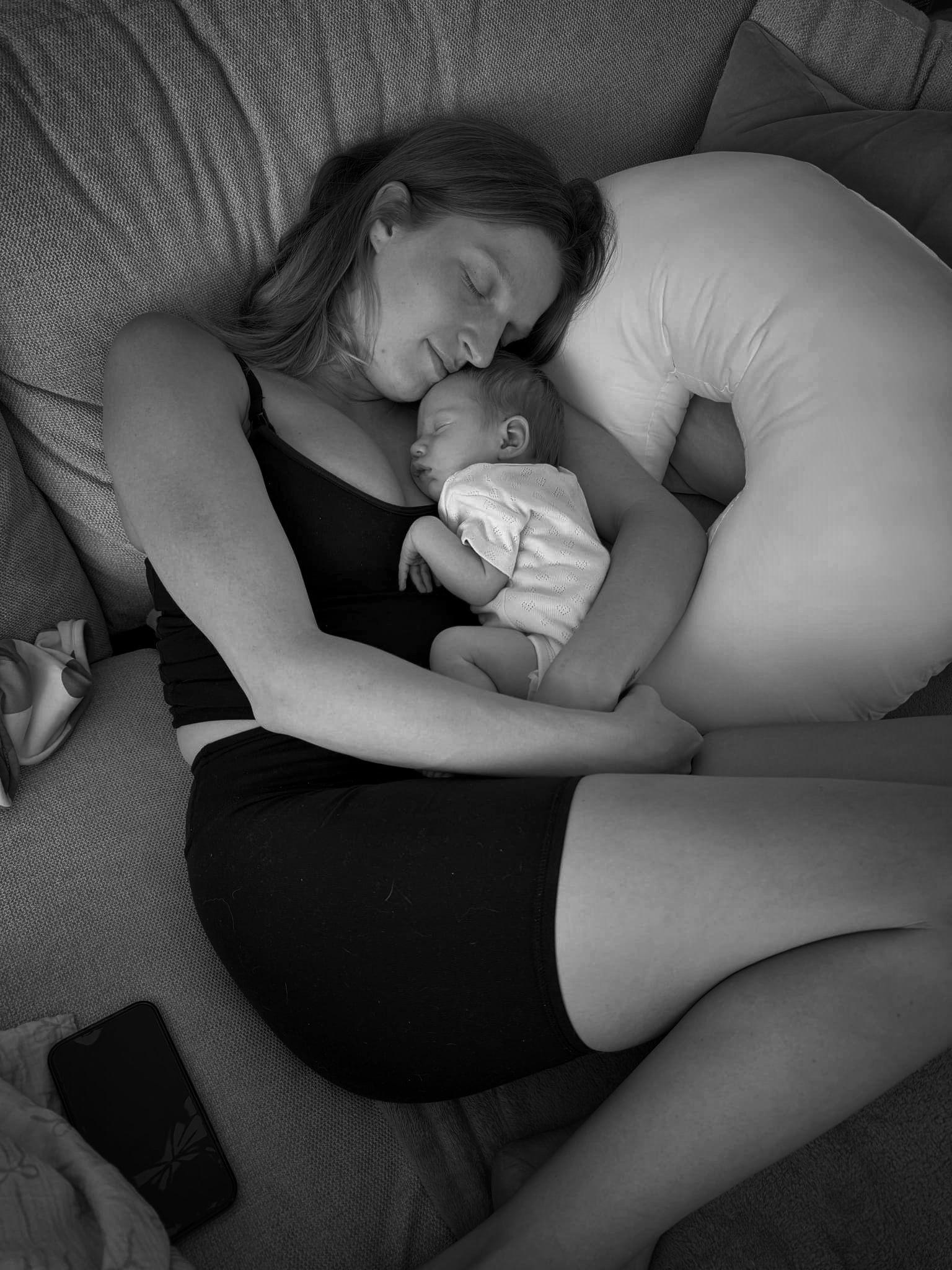
You have tried the cot seventeen times today. Every time, the same sequence: asleep in your arms, transfer, the back touch-down, the pause, the eyes open, the face, the cry.
Your baby will only sleep on you. And you have been awake since 3am and someone keeps texting to ask if you've tried putting them in the cot yet. This article is for you.
Why it happens
It's not a bad habit. It's not a failure. It is developmental biology, doing exactly what it's supposed to do.
Your baby spent nine months in a warm, moving, heartbeat-filled environment. They were never alone. They were never still. The cot, from their perspective, is nothing like anything they have ever experienced. You, on the other hand, are everything they know.
Contact napping - sleeping on a person - is not a modern invention or a parenting style choice. It is what human infants have done throughout history. The drive to be held during sleep is hardwired into your baby. It is not a manipulation. It is survival instinct.
The fourth trimester context
In the fourth trimester, your baby is not developmentally ready to self-settle. The part of the brain responsible for self-regulation is immature. The ability to move from drowsy to asleep without external help is a skill that develops over months, not weeks.
This will change. Most babies develop the capacity for more independent sleep somewhere between three and six months, with significant individual variation. What feels like it will never change, will change - not because you sleep trained, but because your baby's brain matured.
What to do when you're trapped under a sleeping baby
First: you're not trapped. You're doing something real. Contact napping regulates your baby's breathing, temperature, and heart rate. It supports brain development. It is not wasted time. It is, in a real sense, the work.
- Set up before the nap, not after. Water, snacks, phone, headphones, charger - all within reach before you sit down. Accept that you're there for the duration and make it liveable.
- Lie down together. If you're breastfeeding, a safe side-lying position means you can rest even if you can't sleep. Your body recovers more lying down than sitting upright.
- Use a carrier for some naps. A well-fitted carrier means your baby gets contact sleep and you get your hands back. This is not cheating. This is one of the best parenting tools ever made.
- Don't try every transfer, every time. Sometimes you'll get it. Sometimes you won't. Spending forty-five minutes attempting and failing burns more energy than just staying put.
When to think about it differently
Contact napping becomes worth gently working on when it is the only way your baby will sleep, you have no support and cannot sustain it, and the sleep deprivation is reaching a level that is affecting your safety or mental health. At that point - usually after three or four months - there are gradual approaches to working toward more independent sleep that don't involve leaving your baby to cry alone.
Before that point? You are not creating a problem. You are meeting a need. Those are different things, and it matters that you know which one you're doing.
For 3am, when you've been awake since midnight
You are not failing because your baby won't sleep in the cot. You are not weak because you're exhausted. You are not making a rod for your own back by holding them.
You are a person doing something hard, in the dark, because your baby needs you to. That is enough. It is more than enough.
"Contact napping is not wasted time. It is, in a real sense, the work."